Reading Long Form
When you’re reading something long, the only real way to have AI help you is to make it into a summary. But a summary isn’t reading. You lose the author’s voice, the way the argument builds, and whatever you would have noticed on your own. An interface that thinks should help you read the piece, not replace it.
I tried this with Dario Amodei’s essay Machines of Loving Grace, shown as one long page in the type and colors of the original. Claude read it once ahead of time and wrote notes about it, so nothing waits on a model while you read.
The first idea is to show what matters without changing a word.
- Emphasize key information. As you scroll, the key sentences turn teal. Read only those, in order, and they tell the whole essay. When you stop, they ease back to regular text.
- Fade the rest. Everything else dims while you scroll, so skimming follows the thread, and comes back the moment you stop to read.
- Collapse secondary information. Supporting text folds into a small … pill. Rest your pointer on one to open it. A short bridge in the author’s voice can sit inside the pill, so the collapsed essay still reads as one piece.
The second idea is to let you reshape the essay the way you’d reshape a spreadsheet.
- Fold sections into summaries. Each section collapses under its heading behind a summary of a sentence or three. Click it to read the whole section.
- Group lists another way. Dario organizes each list by a principle he never names. A dropdown names it and lets you regroup the list, like by how sure he is or by who has to act.
- Slide through lists as cards. The chunkiest lists become a row of cards you can swipe through.
Every idea can be turned on or off from the Intelligence menu. You can also paste in your own article, and the prototype prepares it for the same ideas in a minute or two.
Do any of these work? I don’t know. Try it yourself.
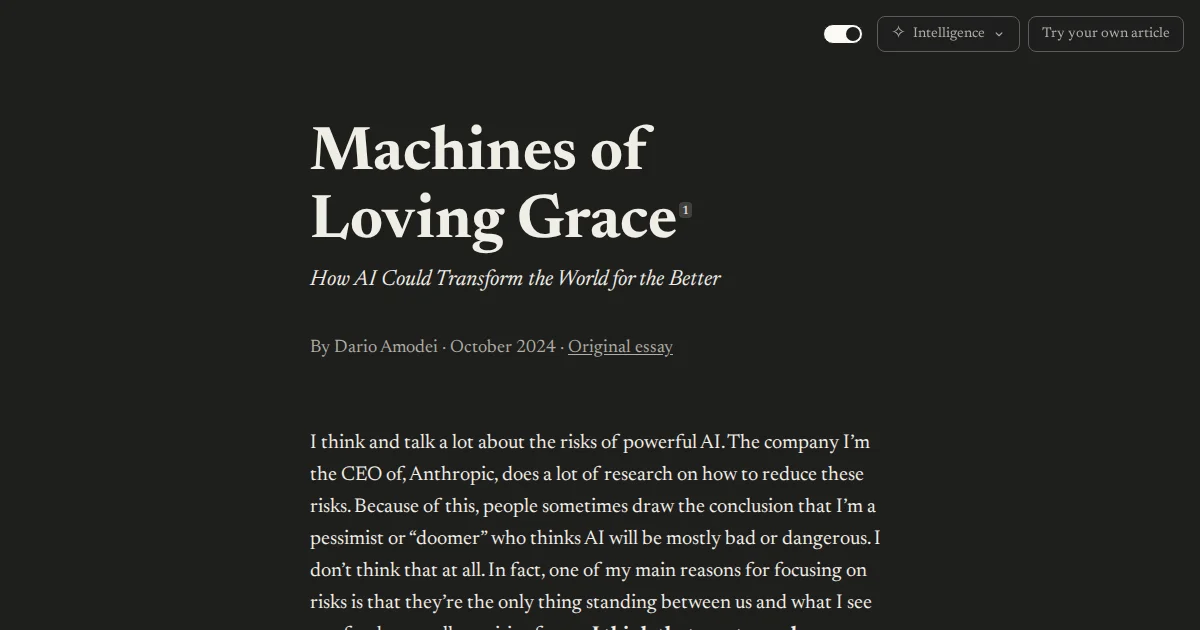 Reading Long Form ↗
Try the prototype in your browser. No API key needed.
tareqistyping.com/prototypes/reading-long-form/
Reading Long Form ↗
Try the prototype in your browser. No API key needed.
tareqistyping.com/prototypes/reading-long-form/It’s open source on GitHub, so you can add a reading idea of your own, adjust the timing, and see what feels right.